

The Most In-Demand Skills Today And In The Future
Source: Extract from World Economic Forum Job Report 2023
Date: October 31, 2023
Disruption.
This one word encapsulates what’s happening in the global labour market, which is constantly being reshaped by the digital revolution, efforts to decarbonize in the face of the climate crisis and other geopolitical and social changes. according to the World Economic Forum's Future of Jobs Report 2023.
The World Economic Forum’s Future of Jobs report finds analytical thinking, creative thinking and AI and big data will be top in-demand skills by 2027.
Leadership and social influence and curiosity and lifelong learning are among other skills expected to see growing demand.
Six in 10 workers will require training before 2027, but only half of workers are seen to have access to adequate training opportunities, according to the report.
In the future jobs market, it will pay to have skills that are in demand.
The World Economic Forum has predicted these likely skillsets – and how demand for them could grow
Between now and 2027, businesses predict that 44% of workers’ core skills will be disrupted, because technology is moving faster than companies can design and scale up their training programmes.
Here are some key growth skills for workers and employers wanting to stay ahead of the change curve. Cognitive skills top the list of those deemed to be of greatest importance for workers in 2023.
- Analytical thinking is considered to be a core skill by more companies than any other skill, making up, on average, 9.1% of the core skills reported by companies.
- Creative thinking comes second, ahead of three self-efficacy skills – resilience, flexibility and agility; motivation and self-awareness; and curiosity and lifelong learning – which recognize the importance of workers' ability to adapt to disrupted workplaces.
"There's more of a focus and an interest in having people with analytical thinking, people with creativity," Saadia Zahidi, Managing Director of the World Economic Forum said in an interview for the Radio Davos podcast on the Future of Jobs Report 2023.
"But it's also become very important to have leadership skills and to have social influence, and the ability to work with other people. The traits that make us human, make us able to relate with each other and to get innovative, creative things done in the workplace."
Analytical thinking also comes high on the list of skills predicted to grow in importance for workers - by 72% over the next five years, businesses report. Their rationale is that reasoning and decision-making are currently the least automated workplace task, and account for just 26% of task automation.
Meanwhile, businesses surveyed for the report believe demand for creative thinking will grow faster in the next five years – by 73% – than demand for analytical thinking.
Technology literacy is the third-fastest growing core skill, while curiosity and lifelong learning; resilience, flexibility and agility; and motivation and self-awareness complete the top five.
Businesses surveyed deemed no skills to be in net decline, but some companies judge reading, writing and mathematics; global citizenship; sensory-processing abilities; and manual dexterity, endurance and precision to be of declining importance for their workers.
Skills training priorities
Six in 10 workers will require training before 2027, but only half of workers are seen to have access to adequate training opportunities today, according to the report. But companies recognize the need to upskill and reskill employees, with 82% planning to invest in learning and training on the job.
AI and big data rank seventh for skills growing in importance today, with 60% growth in demand predicted by 2027.
But when it comes to training priorities for companies over the next five years, AI and big data ranks third and will be prioritized by 42% of surveyed companies, the report found.
Leadership skills, which come ninth in the top skills for 2023 and 11th for skills growing in importance, will be the focus of four in 10 corporate skills strategies.
Upskilling workers in leadership is reported to be a particular priority in the automotive and aerospace and infrastructure industries. It’s also the number one priority in the supply chain and transportation and advanced manufacturing industries.
The fastest growing and fastest declining jobs
In the next five years, almost a quarter of jobs (23%) are expected to change through growth of 10.2% and decline of 12.3%,
Employers anticipate 69 million new jobs to be created and 83 million eliminated - a net decrease of 14 million jobs, or 2% of current employment.
What’s driving the future of jobs?
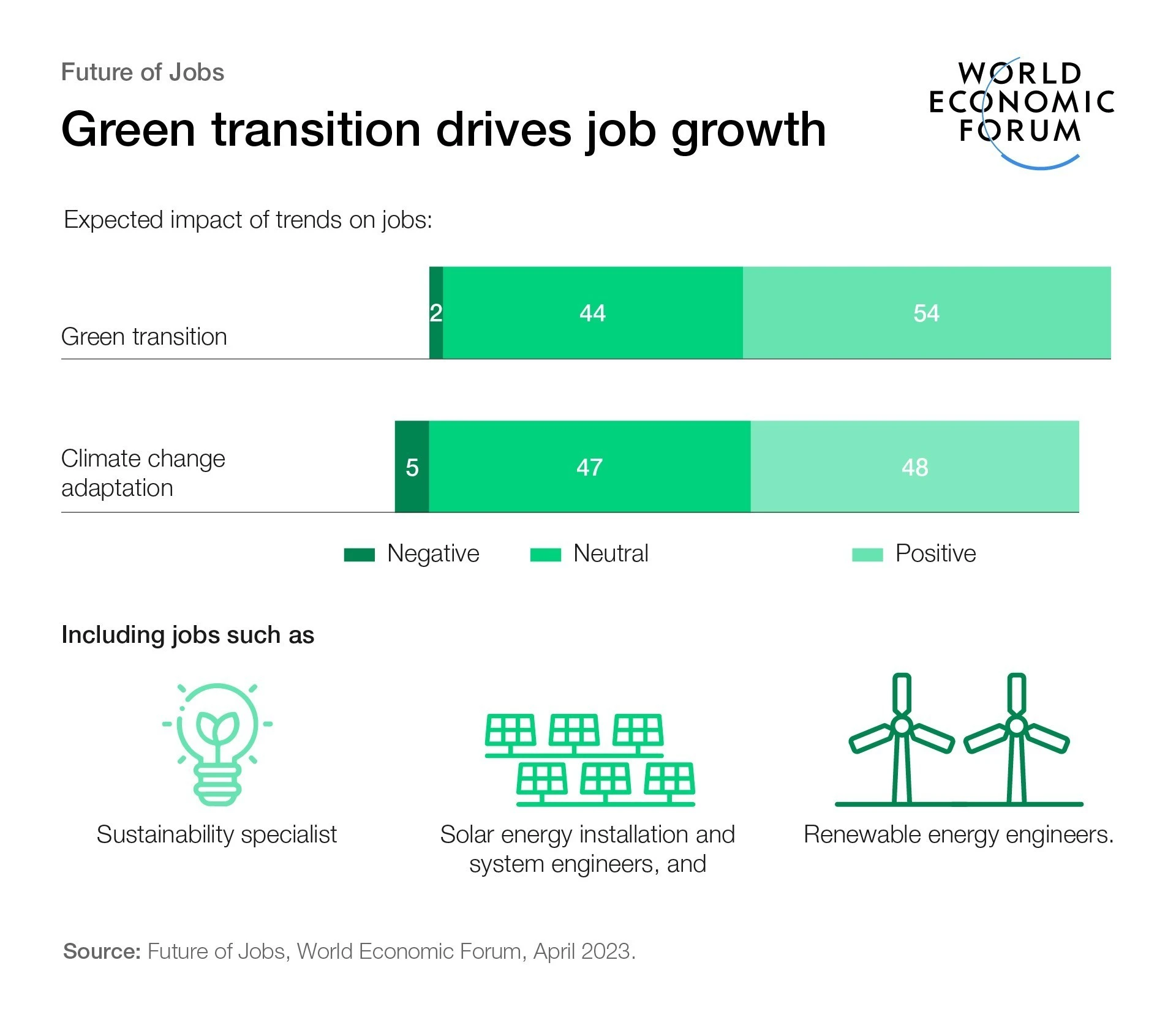
Macrotrends, including the green transition, ESG standards and localization of supply chains, are the leading drivers of job growth, with economic challenges including high inflation, slower economic growth and supply shortages posing the greatest threat.
Advancing technology adoption and increasing digitization will cause significant labour market churn, with an overall net positive in job creation.
More than three-quarters of the 803 companies surveyed for the report are looking to adopt big data, cloud computing and AI technologies in the coming five years.
Autonomous and electric vehicle specialists are in hot demand, topping the list of most in-demand jobs for 2023, with more than 40% growth expected in the coming five years.
Close behind, AI and machine learning specialists could see only slightly less job growth, followed by environmental protection professionals with an expected 35% increase over the same period.
Sustainability specialists, fintech engineers, and several analyst roles – including business, information security, and data – together with data scientists, are each set to see a more than 30% growth rate.
While the digital revolution is a catalyst for some of the fastest-growing occupations, many non-technological roles are expected to see the biggest increases in the total number of jobs created.
Heavy truck and bus drivers, vocational education teachers, and mechanics and machinery repairers look set to see around 2 million new jobs each between 2023-2027, which are among the fastest absolute growth rates of any occupation.
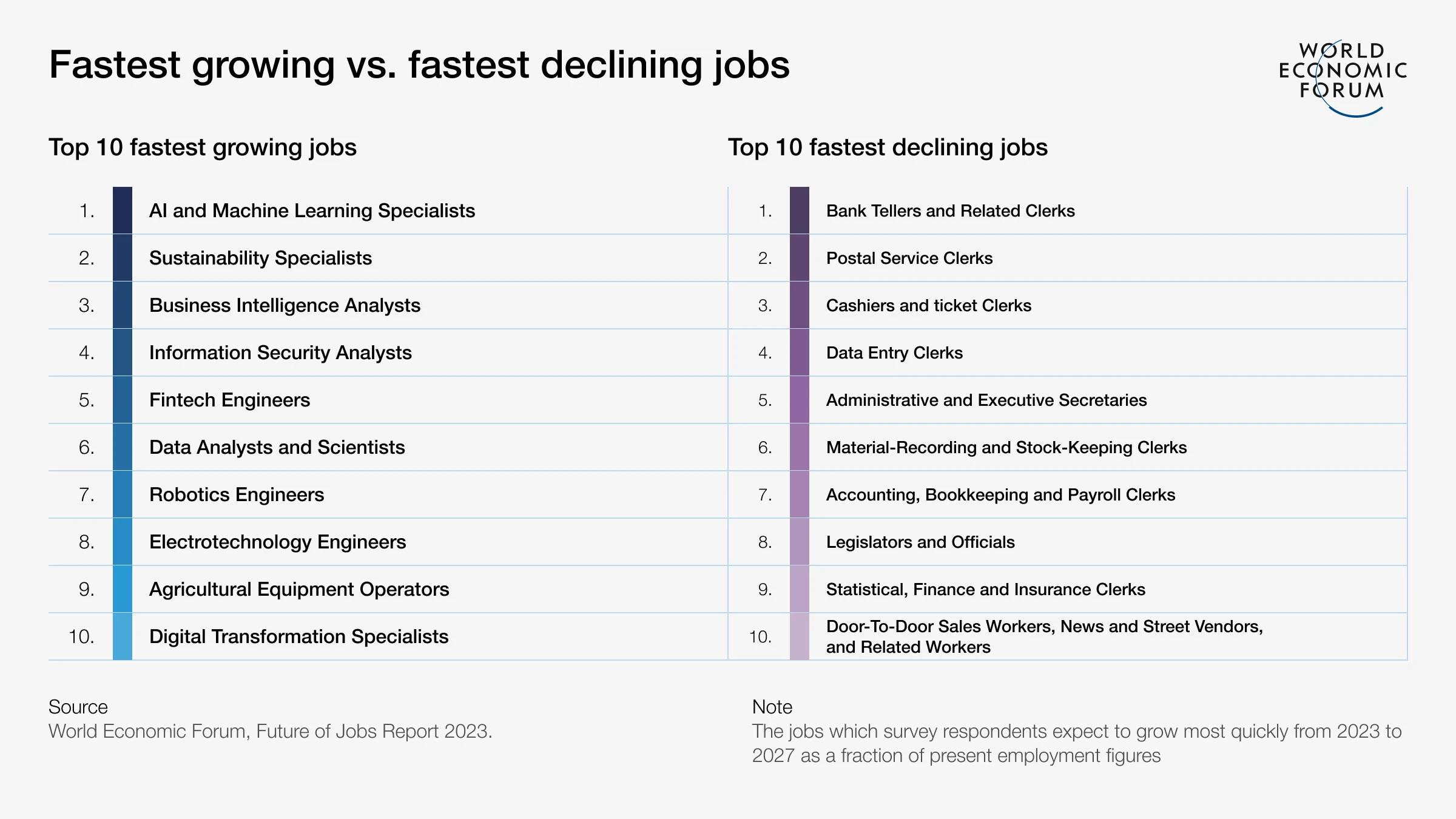
While the sustainability and technical revolutions are causing digital- and sustainability-based roles to balloon, the prevalence of some more traditional roles is expected to fall.
Online banking has led to the closure of many physical bank branches, which leaves bank teller and related clerk jobs expected to see an estimated 40% decline before the end of the decade – the fastest rate of any job.
Similarly, the growing influence of automation, sensor technologies and online services are reducing the need for postal service clerks, cashier and ticket office clerks and data entry staff. These occupations are each expected to decline by more than a third in the coming five years.
In terms of highest absolute job losses, data clerks fare the worst, with an expected 8 million job losses within five years, followed by administrative and executive secretaries, and accounting, bookkeeping and patrol clerks. These three occupations combined account for more than half of total expected job destruction, the Future of Jobs 2023 report notes.
A greener jobs future
To compensate for expected job losses, global efforts to decarbonize in response to the climate crisis are giving rise to a wealth of green jobs across sectors and industries. A green-recovery scenario could generate around 3.5% of additional global GDP growth and a net employment gain of 9 million new jobs each year, according to International Energy Agency data.
The green transition could create 30 million jobs globally in clean energy, efficiency and low-emissions technologies by 2030. But while there has been continued growth in green jobs for the past four years, reskilling and upskilling towards green skills is not keeping pace.
“For people around the world, the past three years have been filled with upheaval and uncertainty for their lives and livelihoods, with COVID-19, geopolitical and economic shifts, and the rapid advancement of AI and other technologies now risks adding more uncertainty,” said Saadia Zahidi, Managing Director, World Economic Forum.
“The good news is that there is a clear way forward to ensure resilience. Governments and businesses must invest in supporting the shift to the jobs of the future through the education, reskilling and social support structures that can ensure individuals are at the heart of the future of work.”