
Counterclockwise Study: The Science Behind Mindset and Aging
Source: rocket50 Staff
Date: November 20, 2024
The following is an amazing story about the correlation between the mind and the body and how, if one truly believes they are younger than the body, physically matches this in better health and actual “de-aging" of our physical limitations.
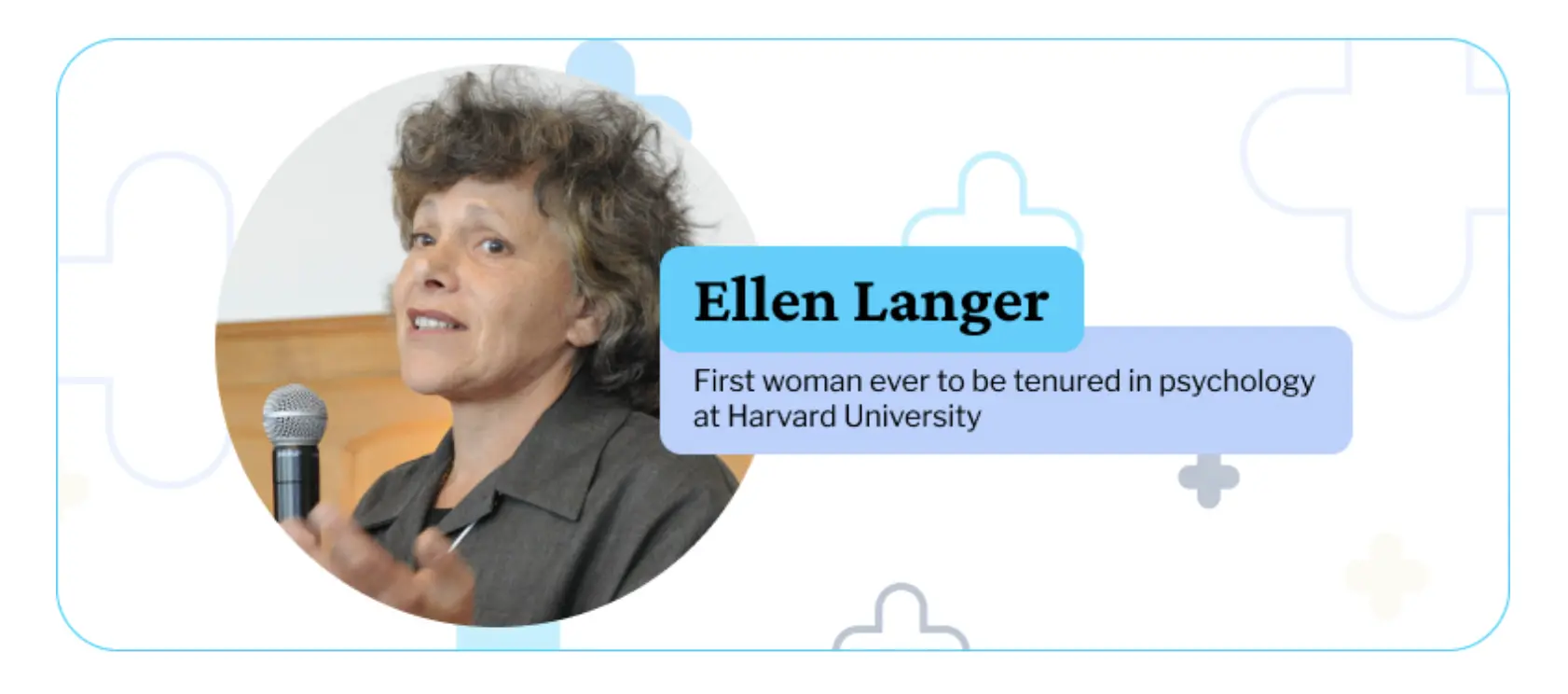
In 2012, psychology professor Ellen Langer appeared on stage to discuss her book Counterclockwise: Mindful Health and the Power of Possibility and some of its most illuminating revelations.
‘The study of possibility is the study of what might be rather than a mere description of what is’, she said during her presentation. ‘Possibility opens up when we recognise the difference between uncontrollable and indeterminate…trying is the key’.
Langer is a pioneering researcher in aging. In 1981, she became the first woman ever to be tenured in psychology at Harvard University in the U.S., where she continues as a professor of psychology today. A social scientist with little regard for convention, Langer earned the moniker ‘The Mother of Mindfulness’ for her work exploring the human mind and all of its untapped potential.
‘When we’re mindless, we’re not there to notice we’re not there’, she said during her appearance. Langer has built her entire 50-plus-year career on that premise, time and again claiming—and proving through original scientific experiments—that mindset matters. A lot!
Our beliefs and expectations about aging, specifically, can have a monumental impact on our health as we get older.
In 1979, Langer conducted an experiment to demonstrate just that.
The Counterclockwise Study
For her experiment, Langer accompanied a group of eight elderly men in their 70s to a residential retreat that was set up to recreate the social-physical environment of 1959.
Her question was: If we turn the clock back psychologically, can we also do it physically?
As Langer explained in her Happiness and Its Causes presentation, the experiment started somewhat inadvertently the moment the group arrived at the retreat. The elderly men had brought heavy suitcases for the week-long stay, and with only Langer there to assist them, they had no choice but to carry their bulky luggage on their own.
What seemed like an oversight at first—not having younger, stronger people present to help unload things—actually set a precedent for the entire retreat. The elderly men couldn’t take a defeatist attitude, or else their suitcases would have been left in the van.
Despite their advanced age, the group successfully hauled the luggage into a residence that was actually more like a time machine. They spent the week sequestered there, in 1959, speaking in the present tense about the past while truly living, believing and behaving as though the clock had turned back two decades. They didn’t simply remember what life was like in 1959—they lived it.
They listened to Perry Como and Jack Benny songs on a 1950s radio. They watched Ed Sullivan on a black-and-white television. They discussed current events, watched movies, flipped through magazines, and even dressed like it was two decades prior. There weren’t any mirrors in the house to disrupt the illusion, either; the only reminders the men had about their appearance were portraits they’d brought of their younger selves.
Outside that residence, it was still 1979.
But inside it, the eight elderly men involved in Langer’s experiment became young again. And by the end of the week, their physical health reflected that psychological reversal of time: they showed substantial improvements in flexibility, dexterity, memory, hearing, posture, cognitive ability and general wellbeing. They even looked younger to outside observers who were shown photos of them before and after the experiment.
The Power of Possibility
To this day, more than 50 years after the experiment, Ellen Langer argues the physical limitations we encounter as we get older are largely determined by how we think about ourselves and our capabilities. The moment those eight men arrived at her experimental retreat in 1979, they were no longer elderly and feeble—if they had been, their suitcases would’ve never made it inside. They spent the rest of the retreat immersed in such a different mindset, that by the end of the week, post-experiment tests showed marked, measurable improvements in a multitude of physical attributes. It wasn’t just psychological anymore: the men quite literally shifted their states of mind and altered their wellbeing. "Health is more than the absence of illness" Langer told the audience at Happiness and Its Causes in 2012. ‘Our mindsets may be the cause of unnecessary limits’. She goes into greater detail about all of this in her book, Counterclockwise: Mindful Health and the Power of Possibility, which was published in 2009 and provides a detailed analysis of the counterclockwise study. But many of Langer’s other experiments have made waves over the years and speak to the power of the mind.
The Chambermaid Study
Her famed Chambermaid Study, for instance, saw a group of hotel maids drastically change their health via the placebo effect. With a simple tweak in perception, the maids began viewing their laborious jobs as exercise, which led to weight loss, blood pressure improvements and increased wellbeing throughout the group.
Langer cites other research that has made similar findings. In one study, for instance, 650 people were surveyed about their attitudes on aging. Twenty years later, those with a positive attitude had lived seven years longer on average than those with a negative attitude. (By comparison, researchers estimate that we extend our lives by four years if we lower our blood pressure and reduce our cholesterol.) In another study, participants read a list of negative words about aging; within 15 minutes, they were walking more slowly than they had before.
"That beliefs might be the most important determinant of life span goes against the grain of what we 'know' to be true," writes Langer. Indeed, by considering whether limbs can regenerate or paralysis be reversed, Langer tries to push science beyond what we know, to discover what might be.