

Changing Jobs At Midlife Is Good For Your Career – And Your Salary

Source: Forbes
By: Avivah Wittenberg-Cox, Contributor - Gender and generational balance - in countries, companies & couples.
Date: March 19, 2024
Thinking of hanging on in your current job until retirement? Think again. New research from the OECD, presented at a recent conference in Paris, strongly suggests that change is good for you – across multiple dimensions: your work, wealth and wellness. The report, done with the support of America’s AARP, is titled Promoting Better Career Choices for Longer Working Lives – Stepping Up Not Stepping Out. It is the third in a series of deep dives into how longevity is impacting work across all 38 OECD countries. The conference showcased the report’s finding on how countries, companies and individuals are adapting to the new longevity’s impact on the future of work.
Workers aged 45 to 64 already constitute a massive 41% of the 2022 OECD workforce, up from 29% in 1990. As younger populations shrink, employers may want to rethink their job recruitment and retention strategies to manage this new generational balance. As individuals stay longer in the workforce, they’ll want to revisit their career planning – and adjust it for longer lives. The 2022 AARP Global Employee Survey revealed that fully half the 45+ workforce was hoping to change jobs with three years. Will companies help or hinder them?
Squiggly Careers Win
The research is promising for the restless, the radical and the newly redundant. Many traditional definitions of success include stability, mastery and linear continuity. The corporate world and its career management systems are built around the ‘ladder’ – an up-or-out vertical climb towards more (power, people, P&L).
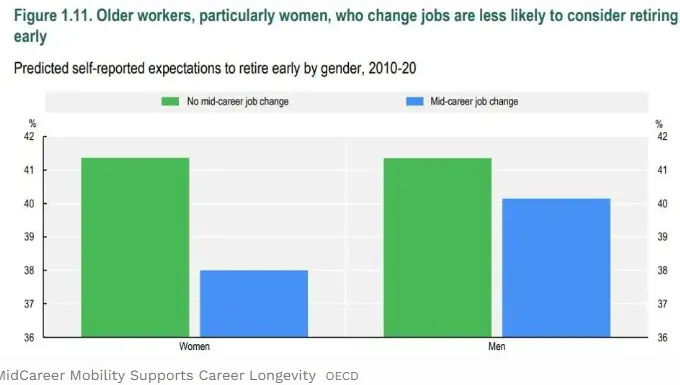
The data gathered by the OECD seems instead to point towards an emerging, longer-living world that rewards disruption, redefinition and mobility. Discontinuity is becoming an opportunity for growth. “Workers who changed jobs mid-career are significantly more likely to be employed at age 60,” says Shruti Singh, the OECD Senior Economist heading up the research. “Older workers who change job voluntarily tend to have wage increases, compared to those who don’t - or are forced to switch jobs.”
It's also essential for the economy. “Effective career mobility is crucial for boosting labour market responsiveness to economic changes and for improved productivity,” notes the report.
Mobility As The New Sustainability
Too bad most of us don’t know that mobility helps employability. Most Q3 (age 50+) workers aren’t (yet) moving. Only 6% of workers aged 55-64 change jobs in any given year across OECD countries. That’s about half the 11% of their younger colleagues, aged 25-44. The majority of those who move benefit - both in terms of work flexibility and mental health.
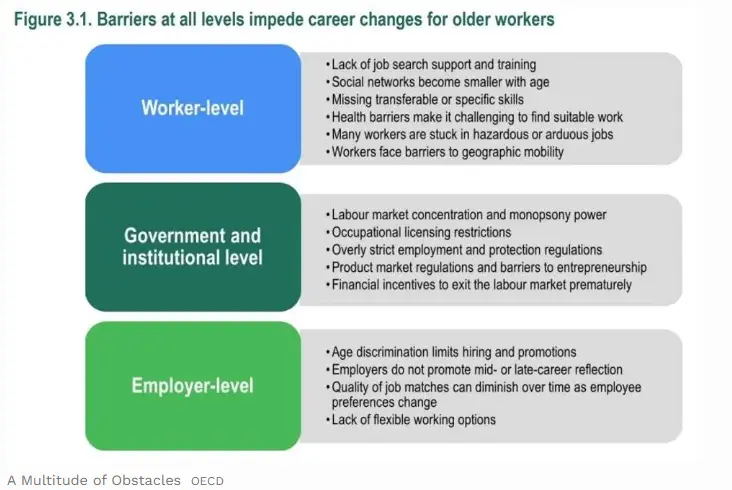
Many workers may yearn for change – but can’t overcome the numerous existing obstacles in their way. Across OECD countries, job mobility has increased - but only by 1.5% between 2012 and 2020. The report lists the multiplicity of hurdles job-changers face: age, location, health, care responsibilities, motherhood penalties, technological change, inflexible jobs, ageism… In addition, adding insult to injury, older workers are less likely to have age-friendly jobs.
No wonder confidence becomes a major issue in facing the very idea of change. “For many older workers with less-than-ideal working conditions,” notes the OECD, “changing occupations can seem so daunting that some do not begin their job search at all.” Conference panelist Richard Alderson, CEO of Careershifters, confirmed that despite all the considerable external obstacles, some of the biggest obstacles were in fact internal ones. So that for many, what they mostly require to move is support and community.
Addressing these barriers is key to unleashing the potential of a massive and growing segment of the population – the older. This should be of interest to both companies and governments facing the growing skill shortages characterizing aging societies that don’t adapt.
 Making Moving Easier – What Companies Can Do
Currently, job mobility falls rapidly with age. Under age 30, 17% of workers change jobs annually. That drops to around 7% by age 45. But if moving contributes to better outcomes for individuals, how do companies and governments make mobility more seamless? Especially for later career shifts? Individuals may be a bit readier to change than employers.
Small signals from employers who are open to older employees’ mobility have a powerful impact, noted Helen Tupper, CEO of Amazing If, during a conference panel. “Our research shows that simply by putting a note at the top of an internal job posting that this position is ‘open to employee mobility’ improved the application rate by 30%.” However, she warned, this didn’t yet translate into improved appointments. Ageism is the current default context in most companies, so hiring managers need to be prepared and trained for more age-neutral mobility and staffing decisions. Getting managers (of all ages) skilled at working across generations is the parallel condition to getting individuals moving.
A corporate panel highlighted two CEOs, Patrice Segui from BNP Paribas Portugal and Laurent Bataille of Schneider Electric France, who were rolling out measures to proactively invest in the retention and development of their 50+ employees. From midlife ...